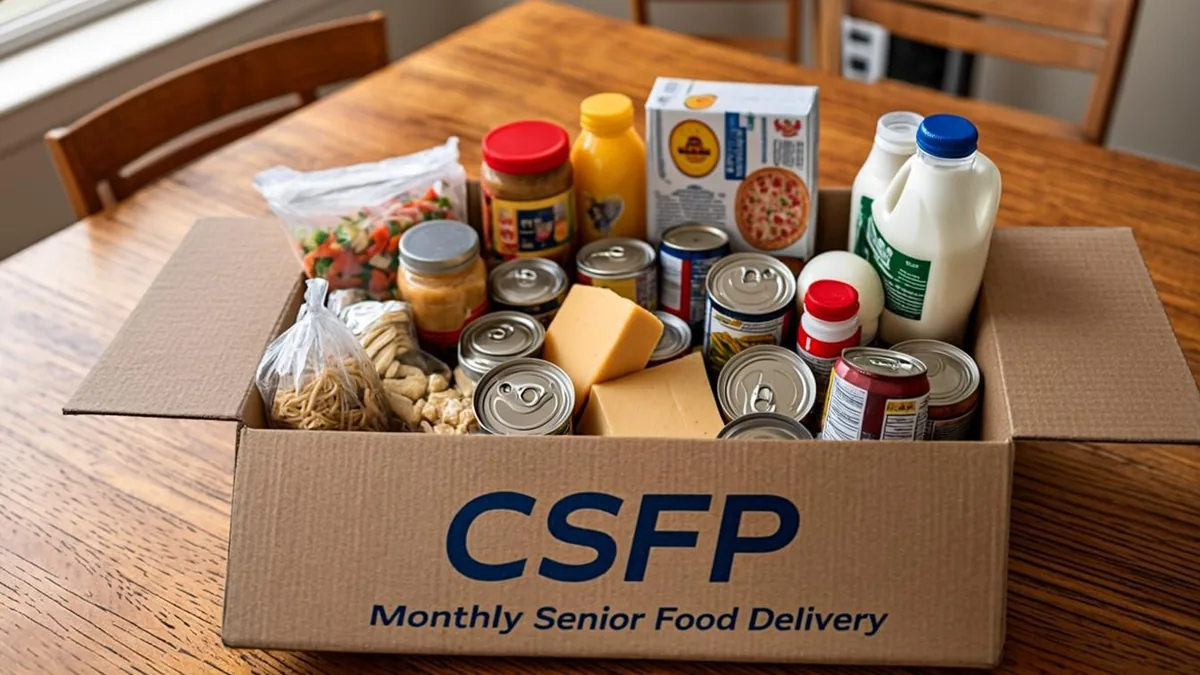
If you are 60 or older, applying for SNAP does not have to mean long forms, stressful interviews, and yearly renewals. Most states now run a simplified application process for older adults — usually called the Elderly Simplified Application Project (ESAP) — that replaces the standard application with a shorter form, skips the interview in many cases, and approves you for 36 months at a time instead of 12.
In Texas, the same idea is branded as the Texas Simplified Application Project (TSAP), and California runs its own ESAP with a special short form called the CF 485. At least 19 states now operate one of these simplified projects, and together they cover millions of seniors. This guide explains who qualifies, how the simplified process differs from regular SNAP, which states offer it in 2026, and exactly how to apply.
What Is the Simplified Application for Elderly?
The Elderly Simplified Application Project (ESAP) is a USDA-approved demonstration project that lets state SNAP agencies streamline how seniors and people with disabilities apply for food assistance. States operate it under a federal waiver that the USDA renews in five-year cycles, and the authority comes from the same section of federal food law (7 USC 2026) that allows other SNAP flexibility projects.
The idea is simple. Older adults who live on fixed incomes — Social Security, SSI, or a small pension — have stable finances. Their income rarely changes, their expenses are predictable, and the standard application asks them questions that do not really apply to them. ESAP strips the process down to what actually matters for these households.
In practice, an ESAP household fills out a shorter application form written in plain language, avoids most interviews, and stays certified for three years at a time. Some states mail the interim paperwork only once during those three years, and several pair the program with a standard medical deduction so you do not have to track every pharmacy receipt.
📌 Quick Facts: ESAP at a Glance
Who it is for: Households where every member is 60+ and/or has a disability, with no earned income.
Form: Shortened, plain-language application (a few pages, not 20+).
Interview: Waived or phone-only in most states, especially at recertification.
Approval length: 36 months instead of the usual 12.
Benefit amount: Exactly the same as regular SNAP — ESAP changes the process, not the money.
Who Qualifies for the Simplified Elderly Application
ESAP eligibility is narrower than regular SNAP eligibility, because the simplified process is designed for households with the most stable situations. Your household must meet all of the conditions below — if even one member falls outside them, you still apply through the regular SNAP process with the senior-friendly accommodations described later.
Every member is age 60 or older and/or disabled
All household members must be 60 or older, or receive disability payments such as SSI, SSDI, or VA disability. A household of a married couple, both 67, qualifies. A grandmother living with her 35-year-old son generally does not, unless the son receives disability benefits.
No earned income in the household
Nobody in the household can be working, because earned income changes often and would undercut the whole point of a three-year approval. Unearned income — Social Security, SSI, pensions, annuities, retirement account withdrawals — is fine and is exactly the income type most ESAP households have.
You buy and prepare food together
Like any SNAP household, ESAP members must purchase and prepare meals together. If you live in the same house but eat separately, you may be able to apply as a separate household — an option that matters for seniors sharing a home with grown children.
You meet the regular SNAP financial rules
ESAP simplifies the paperwork, not the eligibility math. Your gross income still must fall under your state's limit — 200% of the federal poverty level in BBCE states ($2,610/month for one person) or 130% FPL elsewhere ($1,696/month for one person). Asset rules also still apply in the 13 non-BBCE states.
How the Simplified Application Differs From Regular SNAP
The eligibility rules are identical — what changes is everything around them. Here is how the two processes compare for a typical one-person senior household:
| Step | Regular SNAP | Simplified Application (ESAP/TSAP) |
|---|---|---|
| Application form | 20+ page standard form | Short plain-language form, often 2–4 pages |
| Interview | Required eligibility interview | Waived or phone-only; skipped at renewal in most states |
| Approval period | 12 months | 36 months |
| Mid-period contact | Interim report often required | One non-mandatory interim contact, or none |
| Medical deduction proof | Verify every expense over $35/month | Flat standard allowance in several states |
| Benefit amount | Standard allotment | Identical — same math, same EBT card |

The 36-month certification is the biggest practical difference. Under regular SNAP rules, a senior on Social Security fills out renewal paperwork every 12 months and often completes another interview. Under ESAP, one approval covers three years, with at most a single light-touch interim contact in the middle.
⚠️ Important: ESAP Does Not Reduce Your Benefits
Some seniors worry that a "simplified" program means smaller benefits. It does not. Your allotment is calculated with the same income limits, the same deductions (including the medical expense deduction), and the same maximum benefit table as any other SNAP household. The simplified application changes only how you apply and how often you recertify.
States That Offer the Simplified Application in 2026
ESAP is now one of the most widely adopted senior-access projects in SNAP. Based on state agency pages and USDA's SNAP State Options Report, the following states operate an ESAP or an equivalent simplified process for elderly and disabled households as of 2026:
| State | Program Name | Key Feature |
|---|---|---|
| Texas | TSAP (Texas Simplified Application Project) | 3-year approval, shorter form |
| California | CalFresh ESAP | CF 485 short form for seniors/SSI elders |
| Pennsylvania | Simple SNAP application | Abbreviated form for 60+/disabled households |
| New York | ESAP | 36-month certification, no renewal interview |
| Florida | ESAP | Simplified application and renewal |
| Arizona | ESAP | 36-month approval, no mid-approval contact |
| Washington | ESAP (Basic Food) | No interview at recertification |
| Massachusetts | ESAP | Simplified process for 60+/disabled |
| Maryland | ESAP | Streamlined senior application |
| Georgia | ESAP | Simplified senior application |
| Alabama | ESAP | Simplified application for elderly |
| Mississippi | ESAP | Simpler senior enrollment |
| Louisiana | ESAP | 60+/disabled, no earned income |
| South Carolina | ESAP | No interview, 36-month periods |
| Connecticut | ESAP | Federally approved elderly project |
| New Hampshire | ESAP | 36-month "ESAP hold" certifications |
| Arkansas | ESAP | 36-month recertifications in state manual |
| Alaska | ESAP | Senior simplified application option |
| Virginia | ESAP (new for 2026) | Less paperwork for all-older-adult households |
If your state appears on this list, ask specifically for the "elderly simplified application," the "TSAP application" (Texas), or the "ESAP form" when you contact your local office. Caseworkers do not always volunteer the shorter process, and using the standard form by mistake puts you through the full interview and 12-month cycle unnecessarily.
What Stays the Same Under the Simplified Process
ESAP changes the paperwork, not the program's core rules. Your household still passes the same gross income test, still receives the same deductions, and still gets benefits loaded onto the same EBT card on the same schedule. Nothing about the simplified process reduces your allotment or restricts what you can buy.
The income limits are the ones you already know. In BBCE states, gross household income can reach 200% of the federal poverty level — $2,610 per month for a single senior, $5,360 for a four-person household. In the 13 states that still use the federal 130% standard, the limits are $1,696 and $3,483 respectively, per the USDA FNA eligibility chart. Our SNAP income limits and FPL chart for 2026 lists every household size.
The senior-specific financial rules also carry over. Households with a member 60+ keep the higher $4,500 asset limit (versus $3,000), keep the full medical expense deduction for costs above $35/month, and remain completely exempt from SNAP work requirements. If you want the full picture of these rules, our guide to SNAP eligibility for seniors 60+ covers them in detail.
💡 Tip: Claim the Medical Deduction Either Way
Whether you apply through ESAP or regular SNAP, medical expenses above $35 per month lower your countable income. Keep receipts for Medicare premiums, prescriptions, hearing aids, dental work, and transportation to appointments. Some ESAP states let you report a flat standard amount instead — ask your caseworker which method your state uses.
How to Apply Step-by-Step
Applying through the simplified process takes most seniors 20 to 30 minutes on paper, compared with the hour-plus that the standard form demands. Here is the exact sequence:
Confirm your state runs an ESAP or TSAP
Check the state table above, then verify with your local SNAP office. Program rules vary slightly by state — Texas caps participation at households with no earned income, while some states also include younger disabled members. A five-minute phone call settles which process fits your household.
Request the short form by name
Ask for the "ESAP application," the "simplified application for seniors," or in Texas the "TSAP application." Many states let you download it online, pick it up at the office, or have one mailed to you. California seniors use the CF 485 form, and Pennsylvania publishes its Simple SNAP application on the state DHS site.
Fill it out with your income documents nearby
You will list household members, unearned income (Social Security award letter, SSI benefit letter, pension statement), housing costs, utility costs, and medical expenses. The short form asks far fewer questions than the standard application, so this step usually takes 15–20 minutes.
Submit it and skip the waiting room
Return the form by mail, fax, online portal, or office drop-box — whatever your state allows. In most ESAP states the agency processes the form without an interview, or calls you only if something is unclear. Standard processing still takes up to 30 days, and expedited cases still get benefits within 7 days.
Mark your 36-month recertification date
Once approved, note your recertification window — three years out in ESAP states. You will receive one interim contact in many states (often a short mail-in form), then a short renewal package near the 36-month mark. Our SNAP renewal and recertification guide explains how the timeline works in both regular and simplified cases.
Documents You Need for the Simplified Application
The short form needs less paperwork than the standard process, but you should still have proof of the basics. Gather these before you start:
- Identity — driver's license, state ID, or any official document with your name
- Social Security numbers for every household member applying
- Income proof — current Social Security or SSI award letter, pension statement, or annuity statement
- Housing costs — rent receipt, mortgage statement, or property tax bill
- Utility costs — electric, gas, water, or phone bills (these can raise your deduction)
- Medical expenses — Medicare premium notices, pharmacy printouts, and bills for the past 30 days
Our SNAP application documents checklist covers the full list with state-by-state notes. If a document is hard to get — an old award letter, for example — apply anyway and tell the caseworker. Agencies must help you obtain verification you cannot reasonably get yourself, and that protection applies to simplified applications too.
Common Problems Seniors Run Into (and How to Avoid Them)
Most ESAP applications fail for avoidable reasons rather than eligibility ones. Watch for these three:
⚠️ Problem 1: Using the Wrong Form
Family members often download the standard 20-page application for their parents because it is the first result online. The standard form triggers the full interview requirement and the 12-month cycle. Always download from your state agency's ESAP or TSAP page, or request the senior form by phone.
⚠️ Problem 2: Unreported Earned Income
If any household member starts working — even part-time — the household usually leaves ESAP at its next contact. Failing to report it can be treated as an intentional program violation. Report the change promptly; the agency will simply move your case to the regular process, and our guide to SNAP work requirements and exemptions explains the rules that apply next.
💡 Problem 3: Missing the Interim Contact
ESAP reduces mid-period paperwork but does not eliminate it in every state. A short interim form may arrive around month 18. It is easy to mistake for junk mail. Open everything from your state SNAP agency, respond by the deadline, and your three-year approval stays on track. More process detail appears in our guide to the SNAP interview process.
If Your State Does Not Offer the Simplified Application
Roughly half the states still process seniors through the standard application. You still have federal protections that make the process manageable: the right to apply by phone or mail, the right to a phone interview instead of an office visit, the right to designate an authorized representative — a family member, friend, or social worker — to fill out forms and attend interviews for you, and the right to request a home visit if you cannot travel.
States without a formal ESAP often grant 24-month certification periods to households with fixed unearned income anyway, so ask your caseworker whether your case qualifies for an extended certification. Our guide to applying for SNAP online walks through the standard process, and the SNAP deductions guide shows how to make the income math work in your favor regardless of which form you use.
For official program details, read the USDA's Elderly Simplified Application Project page, the Texas TSAP program page, or CBPP's SNAP eligibility guide for the underlying federal rules.
Frequently Asked Questions
What is the simplified SNAP application for seniors?
It is a shortened, plain-language SNAP application offered through the Elderly Simplified Application Project (ESAP) in most participating states, and through the Texas Simplified Application Project (TSAP) in Texas. The form asks fewer questions, the process skips most interviews, and approvals stretch to 36 months instead of 12.
Which states have the simplified SNAP application for elderly in 2026?
At least 19 states operate an ESAP or equivalent simplified process as of 2026 — including Texas (TSAP), California (CalFresh ESAP, form CF 485), Pennsylvania, New York, Florida, Arizona, and others. Your state SNAP office or Area Agency on Aging can confirm whether your county participates.
Who qualifies for the elderly simplified application?
Every member of your household must be 60 or older or receive disability payments (SSI, SSDI, or VA disability), nobody can have earned income from a job or self-employment, and all members must meet the standard net income and asset rules. One disqualified member usually makes the whole household use the regular process.
Does the simplified application reduce my SNAP benefit amount?
No. ESAP and TSAP change only the paperwork, not the math. Your allotment uses the same income limits, the same deductions — including the medical expense deduction seniors often miss — and the same maximum benefit tables as any other SNAP household.
How long does the simplified SNAP approval last?
Approval runs 36 months in ESAP and TSAP states, triple the 12 months under regular SNAP rules. Most states add one light interim contact around the middle of that period, often a short phone call or a one-page form you return by mail.
What happens if someone in my ESAP household starts working?
Earned income ends your household's eligibility for the simplified track, because ESAP is limited to households with no earned income. Report the change promptly — your case simply transfers to the regular SNAP process, and you keep receiving benefits while the switch is processed.
Can a family member apply for SNAP on my behalf?
Yes. Any applicant can designate an authorized representative — a family member, friend, or social worker — to complete the application, attend interviews, and manage paperwork. The form is short, and the arrangement can be revoked in writing at any time.
Is there still an interview with the elderly simplified application?
In most ESAP states, no interview is required at application unless a caseworker needs to clarify something, and recertification skips the interview entirely. Some states substitute a brief phone call. Regular SNAP's standard rules still apply everywhere else.