
Why SNAP Deductions Matter
When you apply for SNAP benefits, the caseworker does not simply look at your gross income and decide whether you qualify. The SNAP program uses a system of deductions — six of them, to be exact — that subtract certain expenses from your income before determining your eligibility and benefit amount. Understanding these deductions is the single most important thing you can do to maximize your monthly food stamp benefits, because every dollar deducted from your countable income directly increases the benefit amount you receive.
Most people only think about the income side of the SNAP equation, but the deduction side is equally important and often overlooked. If you are not claiming all the deductions you are entitled to, you could be leaving hundreds of dollars per year on the table. The difference between claiming your full deductions and claiming none at all can be as much as $200 or more per month for some households, especially those with high housing costs, medical expenses, or dependent care needs.
The SNAP benefit formula works like this: your monthly benefit equals the maximum allotment for your household size minus 30 percent of your net income. Net income is your gross income minus all allowable deductions. So every dollar in deductions reduces your net income by one dollar, which in turn reduces the 30 percent calculation by 30 cents, and increases your benefit by 30 cents. But the real impact is even bigger because deductions can also help you pass the net income test and qualify in the first place, and for households near the eligibility threshold, the difference between qualifying and not qualifying can be worth the entire maximum benefit amount.

The 6 Federal SNAP Deductions
There are exactly six deductions recognized by the federal SNAP program. These deductions are the same in every state, though some of the dollar amounts vary by state and household size. The six deductions are applied in a specific order, and each one reduces your countable income before the next one is calculated. Here is a quick overview of all six before we dive into the details of each one.
The earned income deduction and standard deduction apply to every household automatically — you do not need to verify any expenses to claim them. The shelter, medical, dependent care, and child support deductions only apply if you have those specific expenses. Let us look at each one in detail.
1. Earned Income Deduction (20%)
The earned income deduction is the simplest and most automatic of all the SNAP deductions. If you or anyone in your household has income from working — wages, salaries, tips, or self-employment income — the SNAP program automatically deducts 20 percent of that earned income from your gross income before calculating your net income. You do not need to apply for this deduction or provide any special documentation beyond proof of your earnings, which you already provide as part of the application process.
The purpose of the earned income deduction is to recognize the additional costs associated with working — things like transportation to and from your job, work clothes, payroll taxes, and other expenses that reduce the actual amount of money you have available for food. Rather than requiring you to document each of these work-related expenses individually, the SNAP program simply applies a flat 20 percent deduction to all earned income. This is a rough approximation, but it saves enormous administrative complexity and ensures that working households are not penalized for being employed.
Here is how it works in practice. If you earn $2,000 per month from your job, the earned income deduction reduces your countable earned income to $1,600 ($2,000 minus 20 percent of $2,000, which is $400). That $400 deduction directly reduces your net income, which means your benefit amount will be higher than it would be without the deduction. The deduction applies only to earned income from work, not to unearned income like Social Security, unemployment benefits, or child support received.
For self-employed individuals, the calculation works slightly differently. First, you subtract your business expenses from your gross self-employment income to determine your net profit. Then the 20 percent earned income deduction applies to that net profit. This means self-employed individuals effectively get two layers of deductions — business expenses first, then the 20 percent earned income deduction on top of that. This can result in a significantly lower countable income compared to a W-2 employee with the same gross earnings.
2. Standard Deduction
The standard deduction is another automatic deduction that applies to every SNAP household regardless of your specific expenses. It is a flat dollar amount that is subtracted from your income after the earned income deduction has been applied. The amount varies by state and household size, but it is designed to account for basic living expenses that every household has — things like personal hygiene items, household supplies, and other necessary non-food expenses that are not covered by other deductions.
For the 48 contiguous states and Washington D.C. in fiscal year 2026, the standard deduction amounts are as follows: $204 per month for households of 1 to 3 people, $217 for households of 4 people, $252 for households of 5 people, and $287 for households of 6 or more people. These amounts are adjusted annually by the USDA based on the Consumer Price Index, so they can change slightly from year to year. Alaska, Hawaii, Guam, and the U.S. Virgin Islands have higher standard deductions to account for their higher cost of living.
Like the earned income deduction, the standard deduction requires no verification. Your caseworker applies it automatically based on your household size and state of residence. You do not need to provide receipts or documentation for the expenses the standard deduction covers. It is simply subtracted from your income as part of the net income calculation. The standard deduction is applied after the earned income deduction but before the shelter and medical deductions.
3. Shelter/Utility Deduction
The shelter deduction is often the largest deduction available to SNAP households and can have the biggest impact on your benefit amount. It accounts for the cost of keeping a roof over your head — rent or mortgage payments, property taxes, homeowner's insurance, and utility costs including electricity, gas, water, trash removal, and basic telephone service. Given that housing costs consume the largest share of most low-income households' budgets, this deduction can significantly reduce your countable income and increase your SNAP benefits.
The shelter deduction is calculated as follows: you total up your monthly shelter costs (rent or mortgage, property taxes, insurance, and utilities), then subtract 50 percent of your income after the earned income and standard deductions have been applied. The result is your excess shelter cost, and that is the amount that is deducted from your income. In formula terms: Shelter Deduction = Total Shelter Costs - (Income After Previous Deductions x 50%).
There is an important cap on the shelter deduction for most households. For fiscal year 2026, the shelter deduction cap is $712 per month for households in the 48 contiguous states that do not include an elderly (60+) or disabled member. This means even if your excess shelter cost exceeds $712, you can only deduct a maximum of $712. However, households with an elderly or disabled member are exempt from this cap — their full excess shelter cost is deductible regardless of how high it is. This exemption can make a substantial difference for seniors and people with disabilities living in high-cost areas.
Many states use a Standard Utility Allowance (SUA) instead of requiring you to document each individual utility bill. The SUA is a flat amount that represents the typical utility costs in your state. If your household incurs heating or cooling costs, you can claim the SUA rather than adding up individual utility bills. The SUA amount varies by state and can range from around $300 to over $600 per month. In most cases, using the SUA results in a higher deduction than itemizing your actual utility costs, especially during months with moderate weather when your actual bills might be lower than the standard allowance.

4. Medical Expense Deduction (Elderly/Disabled)
The medical expense deduction is available only to households that include a member who is age 60 or older or has a disability as defined by the SNAP program. This deduction recognizes that elderly and disabled individuals often face significant out-of-pocket medical costs that reduce the income they have available for food. If you do not have an elderly or disabled household member, this deduction does not apply to you.
For households that qualify, the medical expense deduction works like this: you total up all out-of-pocket medical expenses for the elderly or disabled household member, then subtract a $35 standard medical expense disregard. Only the amount exceeding $35 is deductible. So if your monthly out-of-pocket medical expenses are $135, your medical deduction would be $100 ($135 minus $35). If your medical expenses are $35 or less, the deduction is zero because the $35 disregard eliminates it entirely.
Allowable medical expenses include a wide range of costs: doctor and dentist copays, prescription medications, over-the-counter medications prescribed by a doctor, hospital and clinic outpatient costs, nursing home care, health insurance premiums (Medicare Part B, Medigap, employer-sponsored health insurance), transportation to and from medical appointments, attendant care costs, dentures and dental care, hearing aids and batteries, eyeglasses and eye exams, prosthetics, and home health care. The key is that these must be out-of-pocket costs not covered by insurance or other programs.
Many elderly SNAP recipients do not claim the medical deduction because they do not realize they can, or because they think the $35 disregard makes it not worth the effort. This is a mistake. If your out-of-pocket medical expenses exceed $35 per month — and for most seniors on Medicare, they easily do — the deduction can increase your monthly benefit by $30 or more. Over the course of a year, that adds up to $360 or more in additional food assistance. Always report your medical expenses to your caseworker, even if they seem small.

5. Dependent Care Deduction
The dependent care deduction allows you to deduct the full amount you pay for the care of a dependent so that you can work, look for work, or attend job training or education programs. This deduction applies to the costs of caring for children under age 13 and dependents of any age who are incapacitated and require supervision. The dependent care costs must be necessary for you to maintain employment or participate in approved work activities — they cannot be optional or recreational care.
Allowable dependent care costs include licensed daycare or childcare center fees, before-school and after-school care programs, summer day camp costs, babysitter or nanny payments (if properly documented), adult daycare for incapacitated adults, and transportation costs for getting the dependent to and from care. You will need to provide verification of these costs, such as receipts, payment records, or a statement from the care provider indicating the amount you pay.
The dependent care deduction is particularly valuable for single-parent households and families where both parents work. Childcare costs can easily run $800 to $1,500 per month or more, and being able to deduct the full amount from your countable income can make a dramatic difference in your SNAP benefit amount. For a household paying $1,000 per month in childcare, this deduction alone can increase monthly benefits by approximately $300 compared to not claiming it.
6. Child Support Deduction
The child support deduction is the simplest of the six SNAP deductions. If you are legally obligated to pay child support to someone outside your household — and you actually make those payments — you can deduct the full amount of those payments from your countable income. This deduction recognizes that child support payments reduce the income you have available to feed your current household, even though the money technically counts as income before it is paid out.
Only legally obligated child support payments qualify for this deduction. Voluntary payments that exceed the court-ordered amount, informal arrangements, or payments made to someone within your household do not count. You will need to provide documentation of the legal obligation (such as a court order or administrative order) and proof that you are actually making the payments (such as canceled checks, payment records from the child support enforcement agency, or wage garnishment statements).
The child support deduction can be significant for non-custodial parents who have custody of other children or who have formed new households. If you are paying $400 per month in child support, that is $400 deducted from your countable income, which can increase your monthly SNAP benefit by approximately $120. This deduction also helps you pass the net income test if your income would otherwise be too high to qualify.
How Deductions Work Together
The six SNAP deductions are applied in a specific order, and the order matters because each deduction reduces the income that subsequent deductions are calculated against. Here is the correct order of operations for the SNAP net income calculation.
Step 1: Start with Gross Income
Total all income from all sources — wages, Social Security, unemployment, self-employment, etc.
Step 2: Subtract Earned Income Deduction
Deduct 20% of earned income from wages and self-employment.
Step 3: Subtract Standard Deduction
Deduct the flat standard deduction for your state and household size.
Step 4: Subtract Dependent Care
Deduct full amount of dependent care costs needed for work or training.
Step 5: Subtract Child Support
Deduct legally obligated child support paid to someone outside the household.
Step 6: Calculate Shelter Deduction
Shelter costs minus 50% of income from Step 5. Apply cap if no elderly/disabled member.
Step 7: Subtract Medical Expenses
For elderly/disabled: deduct out-of-pocket medical expenses over $35.
Step 8: Result = Net Income
This is your final countable income. Benefit = Max Allotment - (Net Income x 30%).
The key takeaway is that deductions are applied sequentially, and each one brings your income down further. This means that claiming every deduction you are entitled to is not just helpful — it is essential for receiving the maximum benefit amount you deserve. Even small deductions can push you into a higher benefit tier or help you pass the net income test when you otherwise would not qualify.
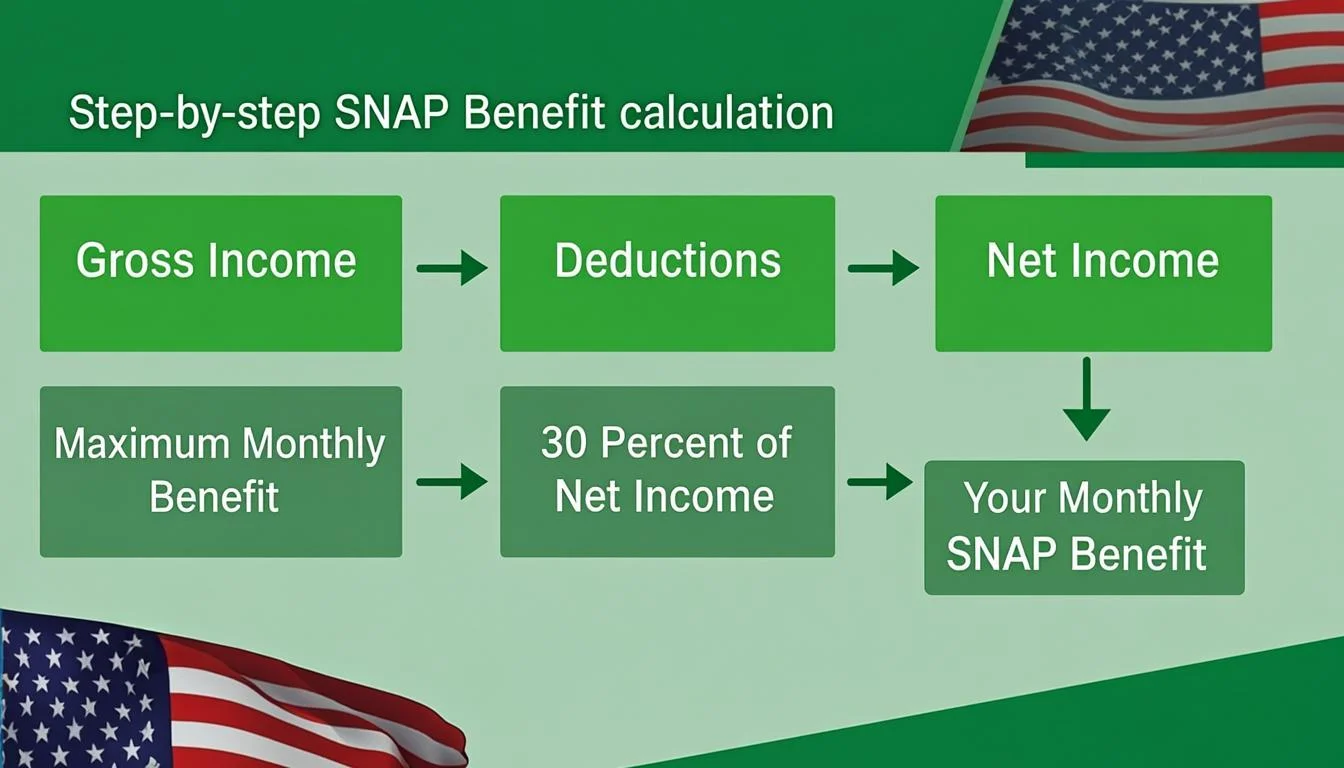
Worked Example: Step-by-Step Calculation
Let us walk through a complete SNAP benefit calculation for a real-world household to see how all six deductions work together. Consider a household of 3 people — a single parent with two children — living in a state with the 48-state standard deduction amounts. The household has the following monthly income and expenses.
Income
- Gross wages: $2,400/month
- Child support received: $200/month
- Total gross income: $2,600
Expenses
- Rent: $1,100/month
- Utilities (SUA): $487/month
- Childcare: $600/month
- Court-ordered child support paid: $0
Without claiming any deductions beyond the automatic earned income and standard deductions, this household would receive only about $251 per month. By claiming the dependent care and shelter deductions, they receive $604 — an increase of $353 per month, or over $4,200 per year. This example shows exactly why understanding and claiming all your deductions is so important.
Tips to Maximize Your SNAP Benefits
Now that you understand how each deduction works, here are practical strategies to make sure you are getting the maximum benefit amount you are entitled to. Many of these tips come from experienced caseworkers and advocates who see people leaving money on the table every day.
Report ALL shelter costs
Do not just report your rent. Include property taxes, homeowner's insurance, condo fees, and all utilities. If your state offers a Standard Utility Allowance (SUA), claim it if you have any heating or cooling costs — the SUA is almost always higher than itemizing individual utility bills. Make sure you are counting the telephone allowance if your state includes it in the SUA or as a separate utility allowance.
Document medical expenses for elderly/disabled members
Keep receipts for every out-of-pocket medical cost: prescriptions, copays, over-the-counter medications prescribed by a doctor, hearing aid batteries, eyeglasses, dental work, and transportation to medical appointments. Report these at each recertification. Even $50/month in medical expenses over the $35 disregard adds $15/month to your benefits — that is $180/year.
Claim dependent care costs
If you pay for childcare, before/after school care, or adult daycare so you can work, report the full amount. Get a statement from your care provider showing the monthly cost. This deduction can be worth hundreds of dollars per month in additional SNAP benefits and is one of the most commonly overlooked deductions.
Report child support you pay
If you pay court-ordered child support to someone outside your household, make sure your caseworker knows about it. Bring your court order and proof of payments. This deduction is frequently missed but can significantly reduce your countable income.
Choose SUA over itemized utilities
In most states, the Standard Utility Allowance gives you a higher deduction than adding up your actual utility bills. If your state offers an SUA and you have heating or cooling expenses (even if you do not pay them separately from rent), always claim the SUA. Check with your caseworker about which utility allowance option is best for your situation.
Common Mistakes That Cost You Benefits
After helping thousands of SNAP applicants, advocates have identified several common mistakes that routinely cause people to receive less than they should. Avoiding these mistakes can put significantly more money on your EBT card each month.
Mistake 1: Not reporting shelter costs. Mistake 2: Thinking the medical deduction is not worth claiming. Mistake 3: Forgetting dependent care costs. Mistake 4: Not reporting changes in expenses. Mistake 5: Using itemized utilities when SUA is higher.State-by-State Differences
While the six federal deductions are the same in every state, some of the specific amounts and rules vary by location. Here are the key state-level differences that can affect your deductions and benefit amount.
Standard Deduction: Standard Utility Allowance (SUA): Shelter Deduction Cap: BBCE Impact: SNAP eligibility calculator